Browsing 19th-century Periodicals

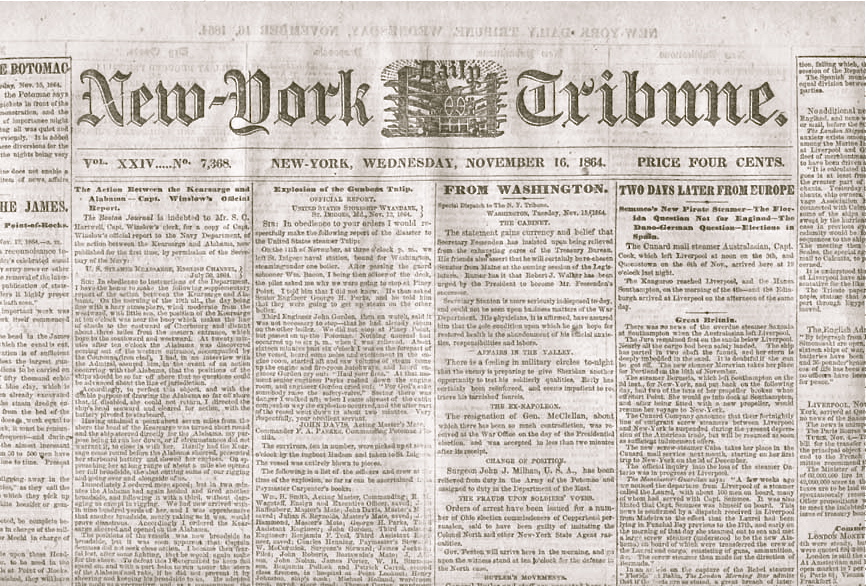
The digitization of 19th-century materials has changed the way literary scholars can research. As a result, we’re both finding new works by established authors (like two new Walt Whitman texts, found by the same graduate student months apart) and works which need more attention. Sometimes looking through the pages of a particular journal can be a window on the changing ideas and fashions of a particular audience.

In this assignment, you group will be working to select a text for deeper investigation, eventually publishing an edited version with historical and literary notes.

The first step will be to browse through 19th-century periodicals and find texts that interest you because they spark interesting historical and literary questions.

Use the Making America Archive from Cornell University

This collection contains generally well-known American periodicals. The scans are usually high-quality.

Making America Journals from Cornell: http://collections.library.cornell.edu/moa_new/browse.html

Limit Your Browsing to issues from 1837-1870.

This is mostly an arbitrary limit. The earliest issues from the Cornell collection are from 1837. The American Civil War ended in 1865, so through 1870 you’ll see articles related to the war and Reconstruction.

Take Notes and Keep Links to Stories to Share with your Group

You can use a shared Google Doc or in your group’s Slack channel (created once your group is created). Share interesting articles with a link and maybe jot down initial reactions, questions, why it might be interesting to explore. Include links so you can find the articles.

If each group member finds 5-10 good stories or essays, you’ll have lots of options for the text you’ll collaborate on. You have to work on that text for a few weeks, so you want something that will keep everyone’s interest and attention.

Don’t do this all at Once

Reading pages of a 19th-century magazine online can get tedious. Spend a few minutes a day browsing or, if the digitized copy you have includes a table of contents, skip around to titles that seem the most interesting.

Definitely Post Questions to Slack

About history, context, more detailed instructions. This is the first time I’m trying something exactly like this and there’s bound to be some snags, but also you’ll be jumping into the wide, weird wold of 19th-century pop culture. You might have all kinds of questions and those are great to share.
How We’ll Carry On. . .

“Under certain circumstances failing, losing, forgetting, unmaking, undoing, unbecoming, not knowing may in fact offer more creative, more cooperative, more surprising ways of being in the world. [. . .] What kinds of reward can failure offer us? Perhaps most obviously, failure allows us to escape the punishing norms that discipline behavior . . . Failure preserves some of the wondrous anarchy of childhood and disturbs the supposedly clean boundaries between adults and children, winners and losers. “

(Halberstam 2-3)

You may have taken an online class before and had a good experience. A well-designed online course is quite effective. Don’t expect that here. This won’t be as effective as a thoughtfully-devised online course and it won’t be as effective as our in-person classes. So let’s jettison the goals of “effectiveness” and “efficiency” for goals that were perhaps more worthy anyway, such as “sharing” and “curiosity.” As noted theorist Jack Halberstam suggests in the epigraph above, if a “successful” course is one that meets a very narrow set of standards, by acknowledging we’ll be a failure, we’re embracing all those other forms our community and learning can take. Let’s fail spectacularly

Let’s also try not to lose our minds. There will be glitches and miscommunications. Don’t sweat them. If you’re not sure about an assignment, or you miss a notification and realize a week later, don’t worry. Send me an email or visit my online office hours (details below). One benefit of being a failure is that we have flexibility. I’ll be doing all I can to help you get the grades you’re aiming for.  

I know that your situation at home is likely chaotic (or excruciatingly monotonous). We’ll be setting up a weekly routine with similar assignments so you know what to expect.

Tools

We’ll be using this course website, email, and Slack for the remainder of the course. If you’re seeing this, you’re already on the course website. You’ve also probably emailed me and received a response. I’ve sent a Slack invitation to you via the email address CUNYFirst has, usually it’s your QC email. If you don’t see my invitation, send me an email and I’ll reinvite you.

Schedule

The schedule page has been updated to reflect our move online. You’ll see that right now, only assignments through 3/26 are posted. That will change in the coming days. Generally, though, I’ll post assignment on the Thursday before they’re due.

Questions

Most of the question that will arise we’ll hash out on Slack, so head there first. If you can’t get on to Slack, though, email me.

*Watch* LWFC

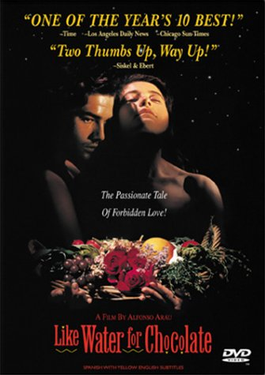
I’ve placed a link to the movie version of the novel. It’s very similar to the novel since Esquivel wrote it herself and she originally conceived of the novel as a move. It may be helpful to explain some scenes, but it also makes some changes. Sometimes the changes are significant (we find out much earlier, for instance, that Mama Elena had another lover, meaning we spend more time possibly being sympathetic for her). Some are minor.

It’s on the Resrouce page under the director’s name “Arau, Alfonso” (so it’s right at the top).

Summaries

Jan

Crying
Christmas rolls remind of Tita
Pedro pops Q and accepts Rosaura on Tita’s cold night.  

Feb

Tragic wedding
Nacha’s death remembering her lost lover
Tear-filled icing
Mama’s warning

Mar

Bloody thorns
Quail in rose petal sauce
The new ranch chef

Apr

Robert’s birth
Tita’s a mother without giving birth
Tita and Pedro finally together?

Tita’s breast become experienced under Pedro’s gaze
Rosaura gives birth
John’s praise and interest in Tita

May

Roberto’s death
Tita’s breakdown
Mama Elena shows a strong personality
Tita against Mama Elena

Jun

Tita’s cold, quiet, with doctor
Contemplates suicide
John explains Grandma, how matches need a match
Tita communicates

Jul

Elena and Chencha’s calamity
Death, rape
Nacha’s omnipresence
Tita’s understanding and engagement
Pedro not letting love go!

Aug

Tita engaged
Esperanza and Tita’s shared fate
Sexual tension resolved
Mama’s Elena’s ghost

Sep

A pregnancy scare causes conflict
Reoccurring pasts brought up again: relationships, hopes and pains

Oct

Tita and Pedro expecting
Gertrudis advises Tita
Elena’s last visit
Pedro burned, baby gone
John’s back

[Resource]: Photos from the Mexican Revolution

Complete

“Mexican-American Border Region–Pictorial works” – It should be unsurprising that the U.S. saw the Mexican Revolution as a threat, especially with the U.S. Civil War only two generations past. Additionally, U.S. companies had significant investment in Mexico that was directly threatened by Mexican revolutionaries who saw these companies as in league with wealthy land owners to mistreat the common folks. Raids by warring military bands threatened civilians on both sides of the border and also created refugees. This collection of black-and-white photographs and some colored prints shows a strong, favorable bias towards the U.S.

Collection Highlights

“General staff of the Mexican Army in the council room of Huerta” – The European influence on the Mexican upper-class is apparent in the uniforms and fashions of the Federal army. Remember also that Diaz was quite old when he left office, and the age of these officials echoes the Diaz regime.

“Mexican Federal Army officers in uniform taken just before the U.S. took Vera Cruz” – The U.S. military briefly occupied the Mexican city of Veracruz in 1914 over a diplomatic dispute. The occupation was deeply embarrassing to the Mexico and fueled popular sentiment that the Mexican government was in the pocket of U.S. businesses. In this photo, more European-style uniforms can be seen along with the civilian clothes worn by the wealthy at the time. Tita’s family is likely in this circle of society.

“Naco, Sonora, federal soldiers at rest stacked arms” – Picture of Mexican Army soldiers.

“Naco, Sonora. Fed. soldiers with soldadera in trench” – The Mexican military was poorly funded, however, and this photo shows that not all soldiers had everything they needed. This photo also shows a soldadera, usually a wife of a soldier who traveled with the army and supported the camp, sometimes even fighting on the front lines. Soldaderas more famously fought alongside rebels, as Gertrudis does.

“Rebel soldiers, Matamoros, Mex” – In contrast, the rebel groups are often made up of poorer people.

“Pancho Villa” – Francisco Villa is one of the most well-known rebel leader in Northern Mexico. Chencha tells tall-tales about Villa’s men eating the hearts out of their victims, echoing both anti-rebel propaganda and indigenous Aztec imagery. Villa was like many rebel leaders who often used the image of the peasant underclass as a symbol for their movement and so would famously don peasant dress for propaganda. This image is from the Library of Congress.

“Carranza Commander in Chief of the rebel Mexican Army / Villa Major General of the Rebel Mexican Army.” – While rebel leaders tried to show they were men of the people by dressing like the poor, they also had to prove that they were responsible future statesmen. In this photograph, Villa and another rebel leader wear European-style uniforms to emphasize their legitimacy.

“Gen. Francisco Villa, shot those canon balls holes. . .” – War produces casualties. When everyone is happy about the turkey mole, Tita remarks that it is a happy moment amidst the death, famine, and destruction the war brings. In this photo, small girls point to the canon ball holes in a local building.

“Refugees at the border awaiting admission to the U.S.” –
A “picture postcard” was a popular souvenir at the time. This shocking post card shows the U.S. military facing down refugees attempting to legally cross into the United States. Chencha is described as crossing this border under the watchful eye of both nations’ armies when she comes home from visiting Tita at Dr. Brown’s. Pedro is detained at this border when Rosaura is giving birth. You might also imagine Pedro and Rosaura as refugee (if you give less credence to the Pedro/Tita relationship and imagine that perhaps Mama Elena just wanted the new family out of harm’s way).

“Electrically-charged wire fence around refugee camp Ft. Bliss, Tex” – Cattle country was beginning to get electrified fences, now common on farms. In this shocking colorized picture postcard, the text draws attention to the use of electrified fence around the refugee camp at Fort Bliss, Texas. The image is strongly resonant with current claims about the treatment of asylum seekers on the U.S. Mexico border and the concentration/internment camps of World War II.

“Detained at the refugee camp” – A shocking photo of children in the refugee camp at Fort Bliss, Texas.

Essay I – Close Reading (Draft due 3/3)

“Criticism must become more scientific, or precise and systematic. . .”

Ransom, John Crowe. “Criticism, Inc.” VQR (1937).

Introduction

Close reading is careful, critical analysis of a short text that focuses on identifying significant details and patterns in order to develop a deep, precise understanding of a text’s form and meanings. It is one of the most important skills for writing about literature.

A close reading has two steps. First, you read (and re-read) the text systematically to produce detailed descriptions of the text’s form and content. Next you make interpretive guesses about the meaning of the text based on the data you’ve unearthed. Being a good close reader requires you to be able to dig deep into a text to keep finding data; and it also requires you to sift through that data to identify the significant details from the insignificant ones.

As with any essay in which you’re making an argument, the goal of an essay based on a close reading is to persuade the audience that the argument is both correct and worthy to be heard (no one wants to have their time wasted with a pointless argument!).

Assignment

Write a short essay in which you identify a theme in Like Water for Chocolate that is dealt with in a way you find thought-provoking. Explain the questions the novel is asking about the theme by doing a close readings, and comparing two scenes in the novel. Write the essay to an audience of professional literary scholars who may have not read LWFC.

Before-you-turn-in-essay Check List

  • Essay is at least 900 words, with the number listed at the end of the essay;
  • Essay is formatted following professional style guidelines (See the Purdue MLA sample paper for specifics on margins, headings, titles, page numbers, Works Cited pages, etc.);
  • All quotations, and paraphrased ideas from other sources have citations;
  • Essay has a Works Cited page that includes all works cited in the essay;
  • Essay has a title that indicates the essay’s main argument;
  • A thesis that clearly identifies a significant theme in the text and explains the comparison the essay will do;

How have we prepared for this essay?

  • In class, we’ve done close readings of the title, the epigraph, and scenes throughout the novel;
  • In class, We’ve defined and used important terms used in literary criticism (symbol, metaphor, imagery, description, diction, subjectivity, meter, rhythm, rhyme, allusion, etc.)
  • In class and in readings we’ve discussed how the “form” and “content” of a text relate
  • We’ve compared the structure of the novel to other serial forms of media;
  • We’ve compared the structure of the novel to other media stereotypically authored by women;
  • We’ve compared documentary evidence to narrative;
  • We’ve read scholarly critiques of the novel.